
|
General
Introduction
SEAFO is a regional
fisheries management organisation in South East Atlantic
Ocean established in line with the provisions of the
United Nations Law of the Sea
(Article 118) and
United Nations Fish Stocks Agreement
(UNFSA). The
objective of its
Convention
(The Convention on the Conservation and Management of
Fisheries Resources in the South East Atlantic Ocean) is
to ensure the long-term conservation and sustainable use
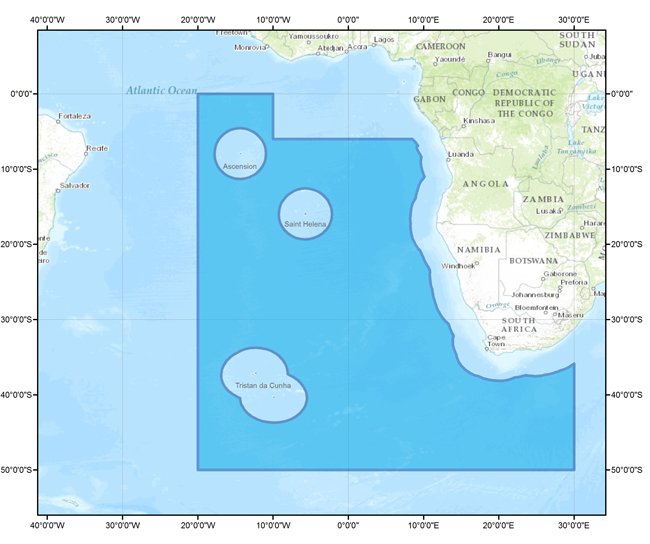
of the fishery resources in the
Convention Area
through the effective implementation of the
Convention.
The
Convention Area
excludes exclusive economic zones of the coastal states in
the region. |
|
The initiative to establish
a regional fisheries management organisation in the region
came from Namibia in 1995 and was shared with and gained
support from coastal states of Angola, South Africa and
United Kingdom (on behalf of St. Helena and its
dependencies of Tristan da Cunha and Ascension Islands).
Various meetings of coastal states took place between 1995
- 1997 where the initial ideas to form a basis for
negotiations were ironed-out and eventually presented to
the first meeting that included other participants with
real interest in the fishery. The negotiations for the
Convention took place between 1997-2001 with several
meetings held within the region and beyond. |
|
The
Convention
was signed in April
2001 in Windhoek by Angola, the European Community,
Iceland, Namibia, Norway, Republic of Korea, South Africa,
United Kingdom (on behalf of St. Helena and its
dependencies of Tristan da Cunha and Ascension Islands)
and the United States of America. It entered into force on
April 2003 after the deposit of instruments of
ratification by Namibia and Norway and approval by the
European Community as required under Article 27
of the
Convention.
States that have participated in the negotiations but have
not signed the Convention are Russian Federation
and Ukraine. |
|
The
Convention
is the first to
create a regional management organisation after the
adoption of the
UNFSA.
Although the
UNFSA
was not in force at
the time of the signature of the
SEAFO Convention
and for that reason did not create an binding obligations
for the participants in the SEAFO negotiations, it
nonetheless formed an essential backdrop to those
negotiations. |
|
From the date of signatures
in 2001, the Ministry of Fisheries and Marine Resources in
Namibia acted as an Interim Secretariat. In March 2005 and
with the appointment of the staff, the permanent
secretariat was opened in Walvis Bay, Namibia. |
|
SEAFO comprises of the
Commission,
the
Scientific Committee,
the
Compliance Committee
and the
Standing
Committtee on Administration and Finance
as subsidiary bodies and the
Secretariat.
The Commission may establish other subsidiary bodies from
time to time to assist in meeting the objective of the
Convention. The Commission has an oversight responsibility
of the Organisation. The Scientific Committee provides
scientific advice on the resources status and on
harvesting levels taking into consideration, among others,
ecosystem approach (Article 3) and
precautionary approach principles (Article 7).
The institutions are designed to function according to the
principles of cost-effectiveness and to expand only at the
same pace as its workload. |
|
Economic important
SEAFO fish species
in the Convention Area include sedentary / discrete and
straddling species such as alfonsino, orange roughy, oreo
dories, armourhead, sharks, deepwater hake and red crab.
The inclusion of discrete high seas stocks takes the
SEAFO Convention
beyond the scope of
the
UNFSA. |